Members
94The best WordPress membership and user role editor plugin. User Roles & Capabilities editor helps you rest...
Free
300k+ installs 4.9★ (1,274)
Import & export events from/to CSV format

Event Organiser CSV is a WordPress plugin that enables you to import and export events using CSV files within the Event Organiser plugin. It allows for flexible mapping of CSV columns to event attributes, accommodating various calendar applications. This plugin is suitable for users who need to manage events across different installations of Event Organiser while preserving specific data not supported by iCal.
The plugin is still in beta, and users can provide feedback or report issues. To use it, you navigate to Tools > Import Events, where you can upload a CSV file for import or export existing events to a CSV file. Users can specify the format and details of the events during the import process, including start and end dates, recurrence details, and associated categories and tags.
Best for: This plugin suits users of the Event Organiser plugin who need to manage events using CSV files.
What it does well
Where it falls short
Event Organiser CSV provides essential functionality for importing and exporting events, though it may require careful handling due to its beta status and specific formatting requirements.
Stephen Harris's own description of Event Organiser CSV, lightly tidied.
This plug-in allows to import events from a CSV file into Event Organiser. You can also export events from
Event Organiser into a CSV file.
Please note that this plug-in still in beta. I welcome feedback, issues and pull-requests.
To allow users to export / import events in CSV format between various calendar applications, and to do this flexiably
so as to limit the number of requirements on the CSV file before it can be read correctly. To allow users to move events
between installations of Event Organiser while preserving data that is not suported by iCal.
In the vein of flexibility columns do not have to be in any prescribed order: you tell the plug-in which columns pertain to what (start date, end date etc)
after importing the file.
Once installed, go to Tools > Import Events. Here you can export a CSV file or select a file to import one. To import an file:
By default the plug-in will only import venues, categories and tags that already exist.
To allow the plug-in to create new venues, categories and tags you can add the following
code (to a seperate plug-in or your theme’s functions.php).
 function my_set_import_imports( $args, $file ){
      $args['import_new_event-category'] =  true; //create category if it doesn't exist
      $args['import_new_event-venue']    =  true; //create venue if it doesn't exist.
      $args['import_new_event-tag']      =  true; //create tag if it doesn't exist.

      return $args;
 }
 add_filter( 'eventorganiser_csv_import_args', 'my_set_import_imports', 10, 2 );
Please note the limitations on importing venues discussed below.
Current limitations apply. See the examples folder for an archetypal CSV file
Please note that in theory all dates (other than the start date) can be given in any format, however, to
ensure dates are interpreted correctly it is strongly recommended to give dates in Y-m-d (or Y-m-d H:i for non-all day events) format. The start
date must be in that format so that the importer can differentriate between all-day and non-all-day events.
Other plugins for moving data.
The best WordPress membership and user role editor plugin. User Roles & Capabilities editor helps you rest...

Manage all your WordPress updates, including individual updates, automatic updates, logs, and loads more. This...

Redux is a simple, truly extensible, and fully responsive options framework for WordPress themes and plugins....

🌠 Shorten, brand, and track any URL on your own domain. Keep your links — and your data — where they belong....
Export WooCommerce orders to Excel, CSV, XML, JSON, PDF and HTML. Best free order export plugin for WooCommerc...
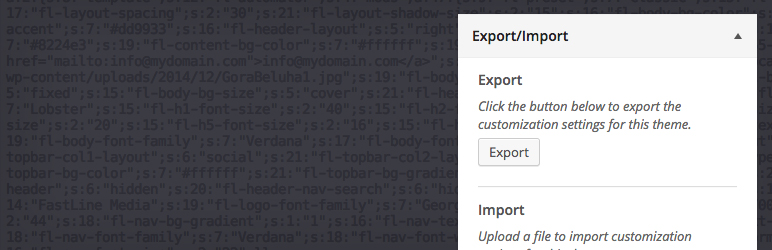
Easily export or import your WordPress customizer settings!